MODULE 1 · STAGE 1: FOUNDATION

Module 1: AI Foundations for Governance

Understand AI well enough to ask the right questions, identify risks and begin governing AI systems with confidence.

What you'll show in Module 1

The critical areas of this module's Knowledge Check.

  • Training vs inference
  • Contextual risk
  • Governance and accountability

How Module 1 works

  1. 1Learn
  2. 2Check
  3. 3Practise
  4. 4Demonstrate
  5. 5Evidence
Sign in to track your progress

Learn

Lesson available
Guided course reader

AI Foundations for Governance

Understand AI well enough to describe a system, challenge assumptions and ask for decision-relevant evidence.

Teaching
90 minutes
Applied context
HireAI
Evidence pack
System Description + Actor Map
01Start hereUnderstand the purpose, learner outcome and practitioner mindset.

Module 1 orientation

Purpose

AI governance begins with an accurate description of the system. Before asking whether an AI system is fair, compliant or well controlled, a practitioner must understand what it does, what information it uses, what output it produces and how that output affects a real decision.

By the end of this module, you should be able to:

  • explain AI in plain language;
  • distinguish AI from fixed-rule software;
  • recognise common learning methods and modern AI system types;
  • separate training from inference;
  • map the AI lifecycle and its main actors; and
  • prepare an AI System Description and AI Actor Map.

The continuing case is HireAI, a fictional CV-screening system. You will not assume that its claims are true. You will separate known facts, assumptions and missing evidence.
021. Understand AI systemsLearn what AI does and how common learning approaches work.
What AI does in everyday productsAI learns patterns from data, then uses those patterns to produce an output.
RecogniseA phone camera detects a face.
PredictA bank estimates whether activity looks unusual.
RecommendA media app suggests what to watch next.
GenerateA model creates text, images, audio or code.

What an AI system does

How an AI-supported decision happensAI turns an input into an output. People and organisations still decide how that output is used.
InputImage, text, transaction or behaviour
PatternThe model applies learned relationships
OutputPrediction, score, recommendation or content
DecisionA person or process acts on the output
A practical definition

Artificial intelligence is software that uses data and patterns to produce predictions, classifications, recommendations, generated content or actions.

An AI system normally has four connected parts:

  1. Input — information such as text, images, transactions or behaviour.
  2. Model or method — the learned patterns or logic applied to the input.
  3. Output — a score, category, recommendation, generated answer or action.
  4. Use in context — the person or process that relies on the output.
Everyday examples

A phone camera recognises the pattern of a face so it can focus. A spam filter predicts whether a message resembles previously identified spam. A streaming service recommends content from viewing patterns. A bank estimates whether a transaction looks unusual.

The output is not knowledge or judgement in the human sense. It is a result produced from data, patterns and design choices. The governance question is therefore not simply, “Does the model work?” It is, “Is this output suitable for this decision, for these people, in this context?”

AI, machine learning and learning methods

Learning from labelled examplesKnown answers teach a supervised model how to respond to a new example.
Labelled examplesInputs paired with correct answers
TrainingThe model learns the relationship
New inputA case the model has not seen
PredictionA class, score or estimate
The relationship

Artificial intelligence is the broad field. Machine learning is one approach within AI in which a model learns patterns from data. Deep learning is a form of machine learning that uses multi-layer neural networks and is especially useful for complex language, image, audio and video data. Generative AI uses learned patterns to create new content.

Supervised learning

Supervised learning uses examples with known answers. A fraud model may learn from transactions labelled “fraud” or “genuine”. A recruitment model may learn from historical shortlist decisions.

This creates an immediate governance issue: labels can contain mistakes or past discrimination. Practitioners should ask who created the labels, whether the examples represent the intended population and how performance differs across groups.

Unsupervised learning

Unsupervised learning searches unlabelled data for clusters, similarities or unusual cases. It may group customer behaviour or identify transactions that differ from a person’s normal activity.

The system discovers a pattern, but people still decide what that pattern means. A cluster is not automatically a fair or useful category.

032. Recognise modern AI typesDistinguish LLMs, RAG, agents, training, inference and unreliable outputs.
Four modern AI patternsThe system type changes the questions a practitioner should ask.
Foundation modelA broad model adapted to many tasks.
LLMA language model predicts and produces text.
RAGRetrieval supplies sources before generation.
AgentA model plans steps and uses tools.

Modern AI systems: models, LLMs, RAG and agents

From a question to a governed actionModern applications may combine retrieval, generation and tool use. Each added capability creates another point to govern.
RequestA user states a question or goal
RetrieveThe system finds approved context
Generate or planThe model produces an answer or steps
Act with controlTools require permission, limits and logs
Model scope and access

A single-purpose model performs a narrow task such as fraud scoring. A general-purpose or foundation model can support many tasks. A model may be proprietary, open source, text-only or multimodal.

Large language models

An LLM produces language by predicting likely sequences from learned patterns. It can draft, summarise and answer questions, but fluent writing does not prove accuracy. A confident invented answer is often called a hallucination.

Retrieval-Augmented Generation

RAG lets a model retrieve information from approved documents before generating an answer. This can make answers more grounded, but the system may retrieve an outdated, irrelevant or unauthorised source. Evidence should show which source was used and whether access permissions worked.

AI agents

An agent can plan steps and use tools. It may send a message, update a record or create a ticket. Because an agent can cause an action, practitioners must define permissions, approval points, logs, reversibility and a reliable stop mechanism.

Training, inference and unreliable outputs

Training and inference

Training is when a model learns patterns from data. Inference is when the trained model receives a new input and produces an output.

Risks can arise at both stages. Training data may be inaccurate, incomplete, unlawful or unrepresentative. During inference, the model may receive an unusual input, be used for a different purpose or operate without suitable human review.

Why outputs can fail

AI outputs may be incorrect, biased, incomplete, inconsistent, difficult to explain or overly confident. Performance can also change when real-world behaviour changes; this is commonly called drift.

Risk depends on context. A poor film recommendation is inconvenient. An incorrect recruitment, credit or healthcare recommendation can affect opportunity, money, rights or safety.

Ask:

  • What failure is plausible?
  • Who experiences the consequence?
  • Can the output be checked before action?
  • How will errors and unequal outcomes be detected?
  • What happens when the system is uncertain?
043. Map lifecycle and responsibilityTrace the lifecycle and identify providers, deployers, users, suppliers and affected people.
Govern the complete lifecycleResponsibility continues after a model is launched.
PlanDefine purpose, owners and affected people.
BuildSelect data, model and suppliers.
TestCheck performance, harm and controls.
MonitorReview incidents, drift and real outcomes.

The AI lifecycle

AI lifecycleGovernance starts before development and continues after deployment.
PlanPurpose, owners and affected people
BuildData, model and system design
TestPerformance, harm and controls
DeployApprove bounded real-world use
MonitorOutcomes, incidents and drift

AI governance covers the complete lifecycle, not only the model-development stage.

  1. Plan — define the purpose, benefit, decision boundary, owners and affected people.
  2. Assess the use case — decide whether AI is suitable and proportionate.
  3. Prepare data — establish source, quality, lawfulness, representativeness and access.
  4. Design and build — select the model, supplier, workflow and human role.
  5. Test — examine performance, fairness, privacy, security, safety and misuse.
  6. Approve and deploy — record the evidence, limitations, residual risk and decision.
  7. Monitor and change — track outcomes, incidents, complaints, drift and model updates.
  8. Retire — remove access, preserve required records and manage affected processes.

A lifecycle record should show who made each important decision, what evidence they used and what conditions were attached. Governance that begins after launch arrives too late to influence purpose, data and design.

AI actors and responsibility

AI systems involve several actors. Their responsibilities must be explicit.

ActorPractical responsibility
ProviderSupplies the model or AI service and relevant technical evidence.
DeployerChooses to use the system and controls its use in context.
UserOperates the system and applies the output.
Affected personExperiences a decision or consequence influenced by the system.
SupplierProvides data, cloud, integration, testing or supporting services.
System ownerRemains accountable for the system’s operation and value.
Risk ownerAccepts, treats or escalates the associated risk.
Control ownerOperates a safeguard and retains evidence that it worked.

A vendor cannot accept the deployer’s accountability for a recruitment decision. A statement that “a human is involved” is also insufficient. The human needs time, information, competence and authority to challenge the AI output.

An AI Actor Map connects each actor to a decision, responsibility and evidence requirement.

054. Apply governance thinkingConnect uncertainty, early risk questions and the HireAI case.

Why governance and risk begin early

Governance sets direction, decision rights, accountability and acceptable boundaries. Risk management identifies uncertainty and decides how it should be treated.

A useful early risk statement connects three elements:

Because of a cause, an uncertain event may occur, leading to an impact.

For example: because historical recruitment data may reflect past preferences, HireAI may rank qualified non-traditional applicants lower, leading to lost opportunities and discriminatory outcomes.

Early governance questions include:

  • Should AI be used for this purpose?
  • Who owns the system, risk and controls?
  • What decisions may the AI support or make?
  • Which people could be affected?
  • What testing and evidence are required before approval?
  • Who can restrict, pause or stop the system?
  • How will complaints, appeals and incidents be handled?

Unknown information is not a reason to invent an answer. It is an evidence gap to record, assign and resolve.

Applied case: HireAI

HireAI is a fictional system proposed for first-pass CV screening. It analyses CVs and application responses, produces a candidate score and recommends who should progress to recruiter review.

Intended boundary
  • It supports first-pass screening.
  • It does not make the final hiring or salary decision.
  • A recruiter should review recommendations before rejection.
  • Candidates should be informed and able to request review.
Known inputs and outputs

Known inputs include CV text, application answers and job requirements. The output is a score and shortlist recommendation. Details about training data, model architecture, subgroup performance and explanation methods remain unknown.

Practitioner focus

The Week 1 assignment does not decide whether HireAI is fair. It first creates a reliable description of the system and maps the actors around it. That description becomes the foundation for the Week 2 harm assessment.

06Review and referenceConsolidate the module and prepare the portfolio evidence.

Module 1 review

Key points
  • AI produces outputs from inputs, data and learned patterns.
  • The output must be assessed in its real decision context.
  • Training creates the model; inference uses it on a new input.
  • LLMs, RAG systems and agents introduce different capabilities and controls.
  • Governance covers the complete lifecycle.
  • Providers, deployers, users and affected people have different roles.
  • Missing information should be recorded as an evidence gap.
Before continuing

You should be able to describe HireAI without marketing language, identify the main actors, explain where human judgement enters the process and state which facts are still unknown. Your homework converts that understanding into an AI System Description and AI Actor Map.

Sign in to record that you have completed this lesson. Sign in

Materials

Slides / course notes

Module 1 — AI Foundations

The full Module 1 lecture deck and course notes (89 slides, 2.1 MB).

Practical exercise

Describe an AI system

Describe an AI system you already use. Identify its purpose, data, users, affected people, potential harms and areas where information is unknown.

Further reading

  • AI system lifecycle
  • Foundation models and LLMs
  • RAG and AI agents
  • AI ownership and accountability

Module 1 homework

HireAI System & Actor Assessment

Review the proposed HireAI recruitment system and prepare a professional AI System Description and AI Actor Map. Use only the fictional information supplied in this case pack and mark unsupported details as unknown.

HireAI is a fictional learning case. Your submission demonstrates practitioner methods; it is not an audit of a live recruitment system.

This homework is your Module 1 evidence. Your trainer reviews it after you pass the Module 1 Check.

Primary case: HireAI. Labs, simulations and self-checks are optional practice; this homework is what you submit.

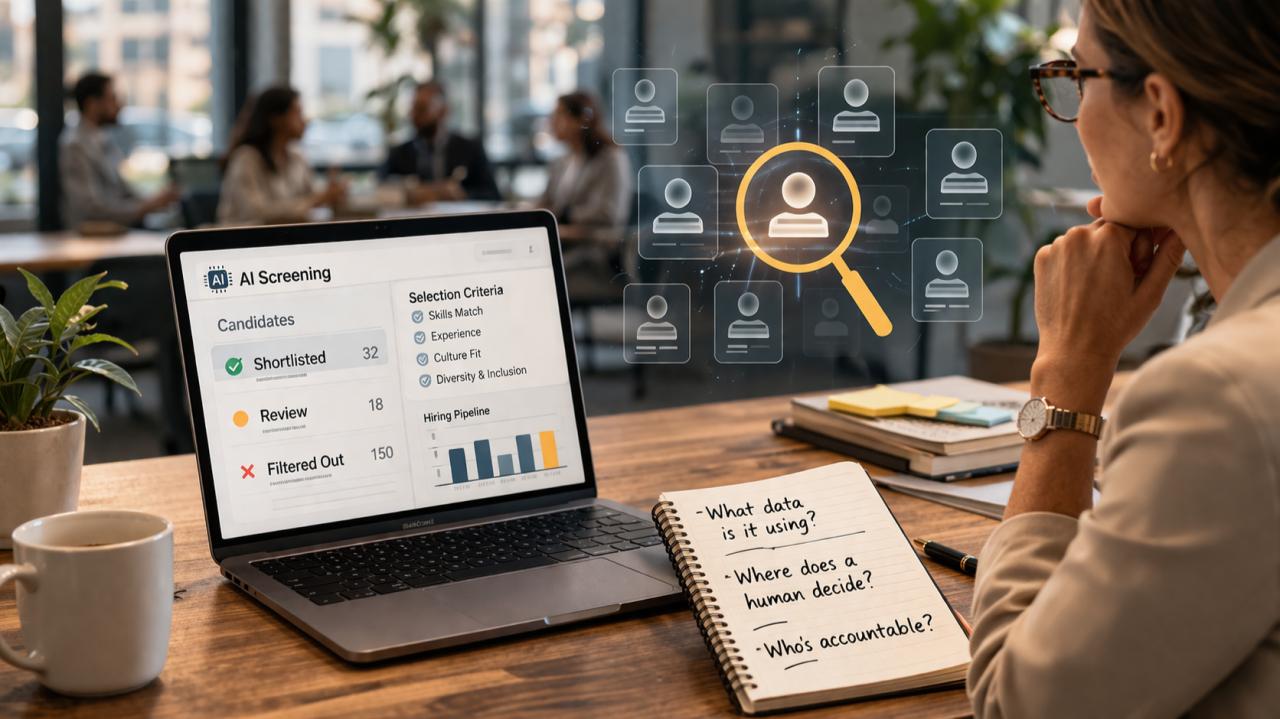
Illustration of an organisation reviewing the governance of AI-assisted candidate screening
Week 1 · AI Foundations

HireAI — Recruitment AI System

Learners act as AI governance analysts reviewing a proposed AI recruitment tool.

Identify what the system does, its AI capabilities, inputs, outputs, users, affected people and lifecycle.

Portfolio output: AI System Description and AI Actor Map.
Your role
AI governance analyst
Applied context
HireAI recruitment system
Decision
Is the system understood well enough to govern?
Portfolio output
AI System Description & Actor Map
Assignment plan

Review the task instructions and marking criteria, then complete the staged submission workspace.

01Tasks 1–2: Describe and classify HireAI

Task 1: Describe the system

Record HireAI's business purpose, users and affected people. Distinguish the intended benefit from the decision it influences.

Task 2: Classify the AI

Describe its capabilities and likely model type. Identify the provider, deployer, users, affected people, suppliers, system owner, risk owner and control owners in the AI Actor Map.

02Tasks 3–4: Trace the decision and governance gaps

Task 3: Trace the decision

Connect the known inputs to the score or recommendation, the recruitment decision and the proposed human review.

Task 4: Establish context and uncertainty

Describe the deployment boundary, potential harms and key assumptions. Write the governance questions that must be answered before Northbridge Recruitment relies on HireAI.

03Submission, quality check and portfolio use

Submit one complete HireAI AI System Description and AI Actor Map containing all fifteen sections.

A strong submission separates known facts, reasonable assumptions and evidence gaps; maps each actor to a real responsibility; and asks decision-relevant governance questions.

Portfolio title: HireAI — AI System Description & Actor Map

Label it: PADEMIQ · AI GRCA Practitioner Programme · Simulated Recruitment Case Study. You may describe it as a hands-on simulated AI governance assessment.

HireAI — AI System Description & Actor Map

0 of 15 answered

All fields are mandatory for completion. You can save a draft before completing them.

Step 1 of 5
Describe HireAI

Establish HireAI's purpose, users and affected applicants from the fictional evidence pack.

Step 1 · Identify the system
Loading your answers…

Checking your review status…

Revision (optional)

Use these to find gaps before or after your Knowledge Check. They don't count towards your badge: only the Check and Demonstrate do.